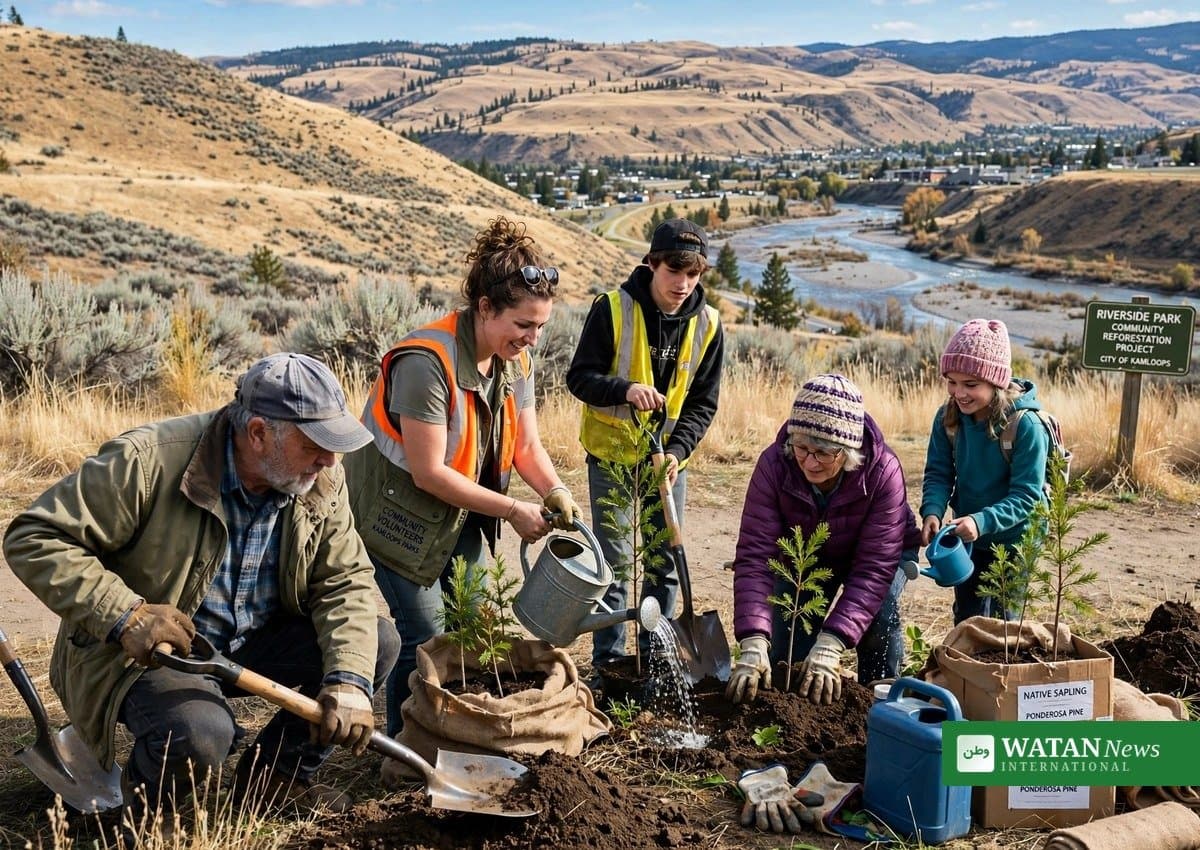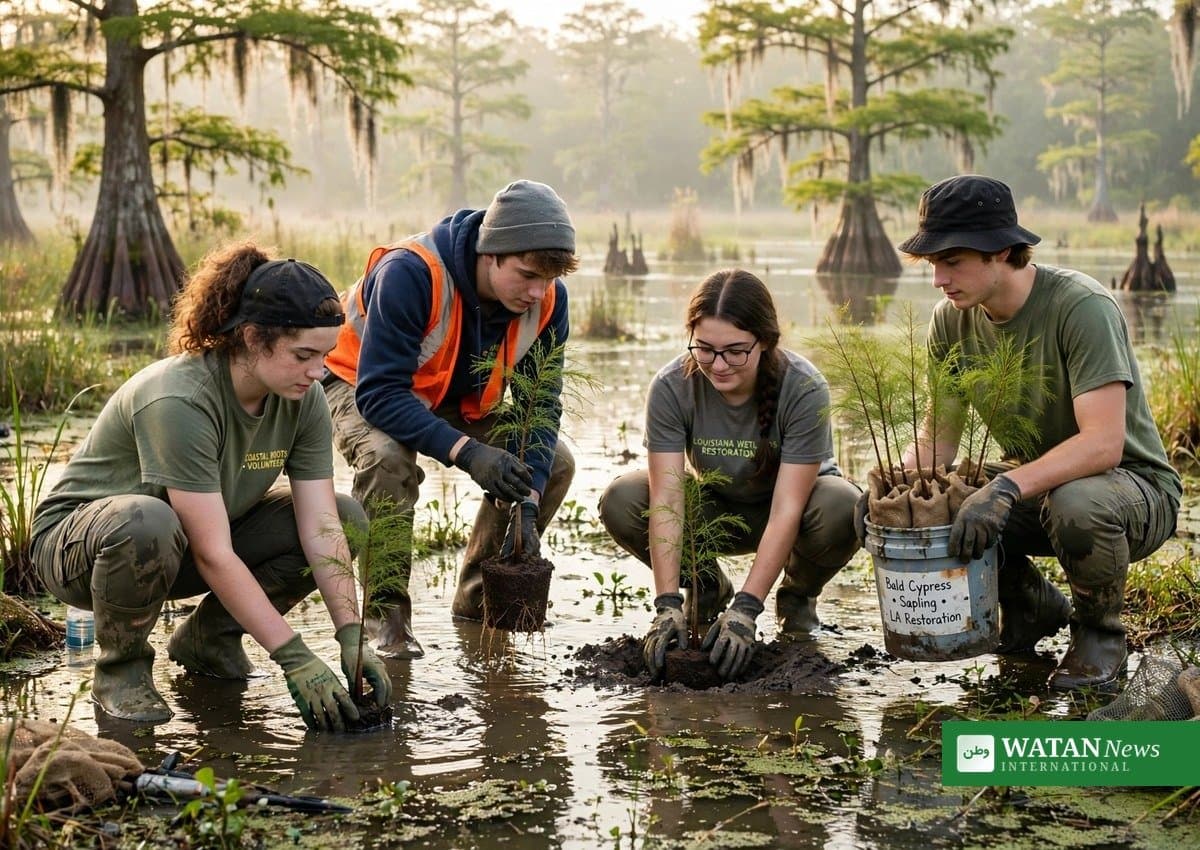
Chalmette, Louisiana, 7 November 2026: Young volunteers from EarthEcho International’s Blue Carbon Ambassador programme are planting bald cypress saplings in the Central Wetlands near New Orleans today, as the 2026 cohort of 13 youth ambassadors turns learning about blue carbon into hands-on restoration across North America.
Today’s planting is led by Blue Carbon Ambassador Gabriel Barnett at the Central Wetlands Unit on Paris Road in Chalmette. It is the first of four public planting days the Louisiana ambassadors will host in the coming weeks: Marlett Hernandez-Fitch leads a second planting at the same site on 21 November, and Natalie Morales and Marlys Hernandez-Fitch will plant at Lake Maurepas on 18 and 19 December.
The ambassadors, aged 17 to 20, come from frontline coastal communities that have historically been excluded from ocean science and policy, according to EarthEcho. Through the programme they learn how kelp, seagrass, mangroves and salt marshes — known as blue carbon ecosystems — store carbon and protect coasts, then design and lead restoration projects in their own communities.
A planting day in the Central Wetlands
The Central Wetlands, east of New Orleans in St. Bernard and Orleans Parishes, were once bald cypress and water tupelo swamp forest. Heavy logging and saltwater intrusion after the Mississippi River-Gulf Outlet canal was built killed much of the forest, but the canal was closed in 2009 and salinity has since recovered, making reforestation possible again.
A coalition of Louisiana organisations, the Central Wetlands Reforestation Collective, is working to plant more than 30,000 trees, 33,000 plugs of marsh grass and 40 plots of aquatic vegetation to rebuild the forest. The work is supported by $715,256 from the National Oceanic and Atmospheric Administration over three years and $404,643 from Louisiana’s Coastal Protection and Restoration Authority over four years, according to the Coalition to Restore Coastal Louisiana.
The Coalition to Restore Coastal Louisiana, one of the collective’s partners, has planted about 10,000 of its 15,000-tree quota, the Associated Press reported earlier this year. Once grown, the trees’ roots will hold the sinking earth in place, create wildlife habitat and help shield the city from storms.
Who the 2026 Blue Carbon Ambassadors are
The 2026 cohort counts 13 ambassadors from six coastal regions across the United States and Canada. In each region, EarthEcho works with a local partner organisation to support youth-led restoration projects.
In British Columbia, KC Fleming from Campbell River is working with North Island College on kelp forest restoration. In Louisiana, Gabriel Barnett, Marlett Hernandez-Fitch, Marlys Hernandez-Fitch and Natalie Morales are working with the Coalition to Restore Coastal Louisiana and the Bayou Youth Leadership Project on salt marsh restoration.
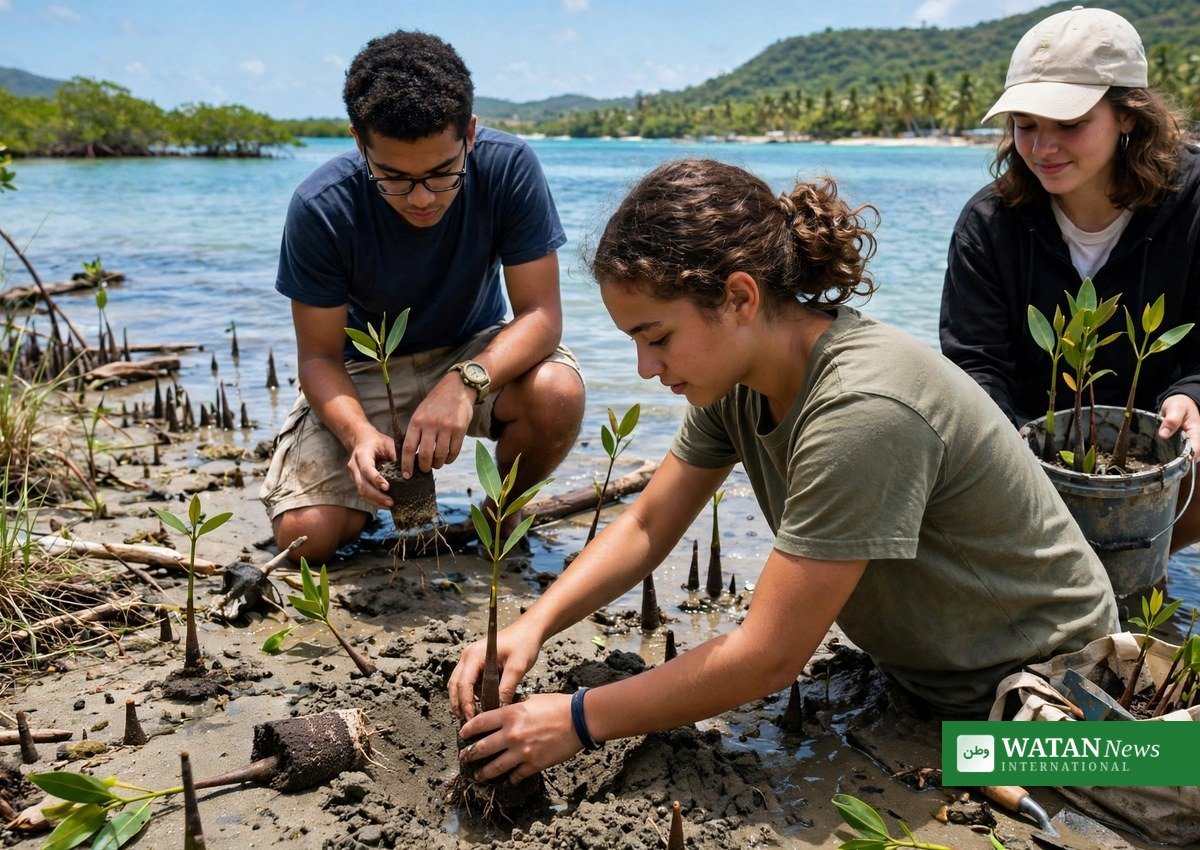
In Maine, Raquel Mendez is working with the Sipayik Resilience Committee on seaweed aquaculture. In Puerto Rico, Esteban Morales Román, Ismael Agosto Rivera, Kamila Pérez and Rui Loureiro are working with Surfrider Puerto Rico to restore mangrove ecosystems. In Charleston, South Carolina, Khamiiah Alameda and McKayla Mamaril are working with the South Carolina Sea Grant Consortium on salt marsh restoration, and in Washington state, Dionicio Lawrence is working with the Puget Sound Restoration Fund on kelp forest restoration.
The programme is supported by the La Mer Blue Heart Oceans Fund and the Estée Lauder Companies Travel Retail division, according to EarthEcho.
What blue carbon means
Blue carbon ecosystems — mangroves, tidal marshes, seagrass meadows and kelp forests — capture and store carbon in their plants and in the soils beneath them. According to the United Nations Environment Programme, the ocean absorbs around 30 percent of human-caused carbon dioxide, and coastal ecosystems are among the most carbon-rich places on Earth.
The same ecosystems also protect people. Mangroves and marshes buffer storm surges, filter water, shelter young fish and support the fisheries and tourism that coastal communities depend on. When they are lost, coasts lose both a carbon store and a natural defence.
That is why the ambassadors’ work pairs planting with learning: the young people study the science, then lead their neighbours in restoring the habitats around them. EarthEcho says the programme builds career skills and opens doors to ocean work that many of the participants could not previously reach.
What the 2025 cohort achieved
The 2025 cohort, 14 ambassadors supported by 21 mentors and alumni, shows what a year of youth-led restoration can add up to. According to EarthEcho, the group engaged nearly 7,000 people, restored 1.17 hectares of habitat, planted 1,735 mangroves along with 179 trees of other species, built two mangrove nurseries in Puerto Rico, cultivated 78.6 metres of kelp and seaweed lines, established a sea lettuce nursery and removed 603.7 kilograms of litter.
Individual projects tell the same story at a human scale. In British Columbia, Acadia Li worked with North Island College on a kelp bioreactor called the BioSeedeX and reached more than 700 people. In New Orleans, Paige Parent, Jyah Hamilton and Bryce Black planted 109 cypress trees in Bayou Bienvenue and tracked the growth of 70 planted the year before. In Puerto Rico, Jarelys Merle Crespo’s EcoCare project planted 1,000 mangroves and 70 native coastal trees and removed about 550 kilograms of marine debris.
The 2026 cohort is building on that record as governments gather for COP31 in Antalya, Türkiye, which opens on 9 November 2026, where ocean protection is on the agenda. The ambassadors’ message is simple: restoration is work young people can start in their own neighbourhoods, and it is already under way.
Key facts
- Programme: EarthEcho International’s Blue Carbon Ambassador Program, for young people aged 17 to 20 from frontline coastal communities
- 2026 cohort: 13 ambassadors from six coastal regions across the United States and Canada
- Today: 7 November 2026 — cypress tree planting at the Central Wetlands Unit, Chalmette, Louisiana, led by Gabriel Barnett
- Coming up: 21 November (Chalmette), 18 and 19 December (Lake Maurepas, Louisiana)
- 2025 results: 1,735 mangroves planted, 1.17 hectares of habitat restored, nearly 7,000 people engaged
- Context: COP31 opens in Antalya on 9 November 2026, with ocean protection on the agenda