LIVE
BREAKING
UN Climate Chief: COP31 Must Turn Climate Promises Into Real-World ActionRiyadh Airport Struck Again: Fire at Terminal 4 as Houthis Claim Second Attack in Two DaysTanker Fire in Strait of Hormuz After US Disables Blockade-Running Cargo ShipCourt Frees ‘Cockroach’ Movement Leaders as Delhi Protests Enter Second DaySuspect Detained After Alleged Assassination Plot Against Poland’s PM TuskRSF Drone Strike Kills 41 at Sudan Displacement Camp Near Ethiopian BorderZelenskiy Offers Energy Truce: Halt Refinery Strikes if Russia Stops AttacksUkraine Strikes Yandex Data Centre in Vladimir, Third Attack in Four DaysFlash Flood Sweeps Away Dozens of Homes in Nepal’s Gorkha DistrictPope Leo XIV to Undergo Lung Surgery This WeekPakistan Imposes Emergency Rule in Khyber Pakhtunkhwa, Suspends PTI-Led GovernmentSJN/MIT Climate Journalism Fellowship 2027: $7,500 Stipend for 10 Local Climate Reporters81% of Europeans Trust the EU Ecolabel, New Survey Finds as Certified Products Top 121,000UK Approves 450 MW Steeple Solar Farm With 150 MW Battery Storage in NottinghamshireEU Environment Ministers Meet in Luxembourg to Debate Carbon Market Overhaul Ahead of COP31 and COP17GGGI Opens Youth Ambassador Applications for Global Green Growth Week 2026Esri’s Jack Dangermond Receives California 30×30 Champion Award for Conservation LeadershipCOP31 Green Zone Opens Free Public Registration Ahead of Antalya Climate SummitPhilippines Puts Climate Literacy in Every Classroom, From Kindergarten to High School2026 Brower Youth Awards: Six Young Environmental Leaders Honoured for Climate ActionUN Climate Chief: COP31 Must Turn Climate Promises Into Real-World ActionRiyadh Airport Struck Again: Fire at Terminal 4 as Houthis Claim Second Attack in Two DaysTanker Fire in Strait of Hormuz After US Disables Blockade-Running Cargo ShipCourt Frees ‘Cockroach’ Movement Leaders as Delhi Protests Enter Second DaySuspect Detained After Alleged Assassination Plot Against Poland’s PM TuskRSF Drone Strike Kills 41 at Sudan Displacement Camp Near Ethiopian BorderZelenskiy Offers Energy Truce: Halt Refinery Strikes if Russia Stops AttacksUkraine Strikes Yandex Data Centre in Vladimir, Third Attack in Four DaysFlash Flood Sweeps Away Dozens of Homes in Nepal’s Gorkha DistrictPope Leo XIV to Undergo Lung Surgery This WeekPakistan Imposes Emergency Rule in Khyber Pakhtunkhwa, Suspends PTI-Led GovernmentSJN/MIT Climate Journalism Fellowship 2027: $7,500 Stipend for 10 Local Climate Reporters81% of Europeans Trust the EU Ecolabel, New Survey Finds as Certified Products Top 121,000UK Approves 450 MW Steeple Solar Farm With 150 MW Battery Storage in NottinghamshireEU Environment Ministers Meet in Luxembourg to Debate Carbon Market Overhaul Ahead of COP31 and COP17GGGI Opens Youth Ambassador Applications for Global Green Growth Week 2026Esri’s Jack Dangermond Receives California 30×30 Champion Award for Conservation LeadershipCOP31 Green Zone Opens Free Public Registration Ahead of Antalya Climate SummitPhilippines Puts Climate Literacy in Every Classroom, From Kindergarten to High School2026 Brower Youth Awards: Six Young Environmental Leaders Honoured for Climate Action
Climate

Philippines Puts Climate Literacy in Every Classroom, From Kindergarten to High School

Usman javedPublished October 11, 2026
Philippines Puts Climate Literacy in Every Classroom, From Kindergarten to High School
Share this story

MANILA — The Philippines is putting climate literacy on the timetable. The country’s Department of Education (DepEd) is weaving climate change into the basic education curriculum, from kindergarten to junior high school, while ordering schools to prepare for extreme heat and the anticipated El Niño — a nationwide push officials say will reach millions of learners.

Education Secretary Juan Edgardo “Sonny” Angara has directed the fast-tracking of climate concepts into basic education learning competencies, following directives from President Ferdinand R. Marcos Jr. The move pairs new lessons with operational measures designed to keep learners safe when heat indices spike.

“Climate literacy must start early, and it must start in our classrooms,” Angara said, according to the announcement.

How climate literacy will be taught

Under the updated basic education curriculum, climate-related concepts will be introduced progressively across grade levels:

Kindergarten to Grade 3

The youngest learners will focus on basic environmental care and protection — simple, actionable habits that build stewardship from the start.

Grades 4 to 6

Pupils will evaluate environmental concerns such as air quality and waste management, connecting classroom learning to the world around them.

Junior High School (Grades 7 to 10)

Students will explore the scientific drivers of global warming, mitigation strategies and global climate advocacies in depth.

These competencies are embedded across four core learning areas. In Science for Grades 9 to 10, lessons focus on the evidence of global warming, greenhouse gases, biodiversity conservation during environmental crises and local climate solutions — including renewable energy adoption. Good Manners and Right Conduct (GMRC) for Grades 1 to 3 and Values Education for Grades 7 to 10 emphasize the family’s response to climate issues, conservation of food, water and power, and participation in local and global environmental advocacies.

Physical Education and Health for Grade 6 addresses environmental concerns and climate impacts through the One Health concept, while Edukasyong Pantahanan at Pangkabuhayan (EPP) and Technology and Livelihood Education (TLE) for Grades 4 to 10 teach practical mitigation skills and adaptive farming practices.

Heat preparedness in schools

Alongside the curriculum changes, DepEd is strengthening operational protocols to help schools cope with rising temperatures. The preparedness strategy centers on continuous risk assessments, updated contingency plans and flexible learning options to protect learners and personnel during extreme heat.

Schools have been directed to prioritize heat and water security: setting up safe drinking water, maintaining water, sanitation and hygiene facilities, fixing leaks and improving classroom ventilation. Authorities may adjust class schedules or shift to alternative learning modalities when heat conditions become unsafe.

DepEd is also strengthening school-level monitoring and reporting systems to track heat index levels, water availability, class suspensions and health incidents in real time, so resources can be directed where they are most needed.

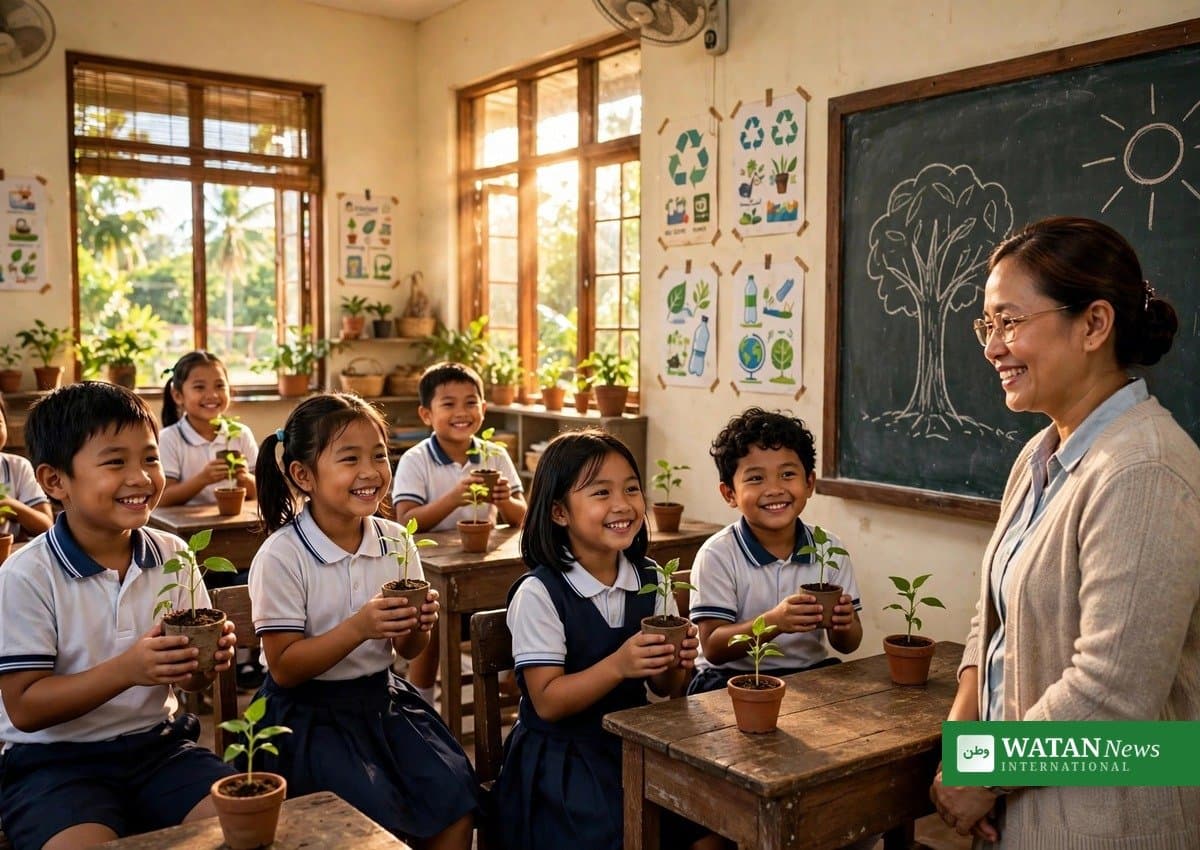
Students planting seedlings in a school garden during a climate literacy activity
Students plant seedlings in a school garden — DepEd’s updated curriculum pairs climate literacy with hands-on environmental activities.

Students as climate actors

To complement classroom lessons, DepEd is encouraging school-level activities through the Youth for Environment in Schools Organization (YES-O), where student clubs organize environmental activities such as campus waste segregation, local cleanups and drainage maintenance to prevent trash from blocking waterways.

Angara stressed that the work cannot stop at the school gate. “Disaster preparedness and climate change adaptation are matters of shared accountability,” he said. “DepEd will do its part by embedding these real-world solutions into our curriculum so that every learner knows their role in safeguarding our environment.”

He emphasized that effective climate action requires coordination among schools, local government units and families to mitigate risks before extreme weather hits — a reminder that raising public awareness about climate and the environment is a collective task. Readers can follow more of Watan News’ coverage in the climate section.

FAKTA: Climate literacy in Philippine schools

  • What: The Philippines’ Department of Education is embedding climate literacy across the basic education curriculum, from kindergarten to junior high school.
  • Why: Extreme heat and the anticipated El Niño threaten learners; the move follows directives from President Ferdinand R. Marcos Jr.
  • Who: Education Secretary Sonny Angara ordered the fast-tracking of climate concepts into learning competencies.
  • The classroom plan: K–3 focuses on environmental care; Grades 4–6 on air quality and waste management; Grades 7–10 on the science of global warming, mitigation and advocacy.
  • The safety plan: Heat and water security in schools, flexible class schedules, and real-time monitoring of heat index levels, water availability, class suspensions and health incidents.
  • Student action: The YES-O programme channels student clubs into waste segregation, cleanups and drainage maintenance.

Why it matters

The Philippines is among the countries most exposed to climate impacts — from typhoons to extreme heat — and schools are often the first to feel them. By pairing curriculum reform with heat safety measures, DepEd is treating climate literacy not as an extra subject, but as a basic life skill. If implemented at scale, the policy could shape how a generation of Filipinos understands and responds to a changing climate.

Related Stories

Planet & environment

Climate & Sustainability

News, stories and solutions driving change towards a greener and more sustainable planet for future generations.

UN Climate Chief: COP31 Must Turn Climate Promises Into Real-World Action
Featured story

UN Climate Chief: COP31 Must Turn Climate Promises Into Real-World Action

NADI, Fiji — With four weeks to go before COP31 opens in Antalya, Türkiye, the United Nations’ top climate official has urged governments to make the summit the moment climate promises finally become real-world results. United Nations Framework Convention on Climate Change (UNFCCC) Executive Secretary Simon Stiell said every economy is already paying the price

Read full story

GREEN JOURNALISM

UNESCO: At least 46 Environmental Journalists Killed Since 2010 — Protecting Press Freedom Protects the Planet
Green Journalism

UNESCO: At least 46 Environmental Journalists Killed Since 2010 — Protecting Press Freedom Protects the Planet

Awareness article: Climate reporting is one of the most dangerous beats in modern journalism. UNESCO data shows that environmental journalists are attacked, threatened and in some cases killed for their work — and that protecting the press is a prerequisite for protecting the planet. Journalists who investigate illegal logging, poaching, pollution and the climate crisis

Read full story
How the Washington Post’s ‘Floods Above’ Won the Poynter Climate Journalism Prize
Green Journalism

How the Washington Post’s ‘Floods Above’ Won the Poynter Climate Journalism Prize

WASHINGTON – The Washington Post’s sweeping investigation into the world’s rising flood danger, Floods Above, has won the inaugural Poynter Journalism Prize for Excellence in Climate Change Reporting, a new award for scientifically grounded climate journalism announced by the Poynter Institute. The prize, sponsored by the Hennecke Family Foundation, recognizes rigorous reporting that enlightens and

Read full story

Every Action Counts

Small steps today, big impact tomorrow.

Explore more stories