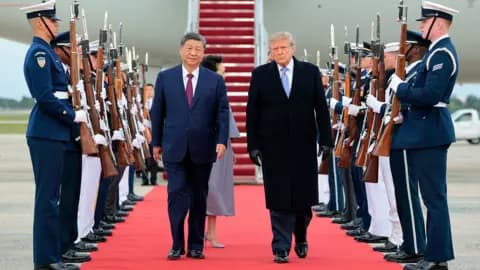
President Xi Jinping received a high-profile reception from President Donald Trump during his recent visit to the United States. Despite the ceremonial fanfare, the Chinese leader did not secure all of his desired outcomes from the high-stakes summit.
China’s primary objective in these meetings is to counter what it perceives as US efforts to contain its ascent as a global superpower. Beijing seeks to ensure Washington refrains from interfering in its strategic interests, particularly concerning trade, technological advancements, and the sensitive issue of Taiwan.
- China aims to prevent US obstruction of its superpower growth.
- Key areas of concern include trade, technology, and Taiwan.
- Xi Jinping sought assurances of non-interference from the US.
The summit’s outcome revealed a mixed bag for President Xi. While Trump extended a significant red carpet welcome, the tangible results fell short of Beijing’s expectations on several critical fronts.
A crucial point of contention was the trade truce that had temporarily halted a escalating tariff war between the two nations. This pause, initially set to expire in November, was extended by only a few months, pushing the deadline to January.
Beijing had been hoping for a more substantial extension, ideally for at least a year. This would have allowed Xi Jinping to navigate through the remainder of Donald Trump’s presidency with greater trade stability.
- The trade truce was extended from November to January.
- China had sought an extension of at least one year.
- This short extension indicates ongoing trade disputes.
The limited extension means that significant disagreements regarding tariffs, China’s control over rare earth supplies, and its access to advanced US semiconductor technology are deferred. These complex issues will now be subjected to further rounds of negotiations.
This outcome suggests that the United States is looking for more substantial concessions from China. Washington appears to want Beijing to demonstrate greater commitment to its promises before offering any long-term trade accommodations.
The uncomfortable reality for President Xi Jinping is the current state of China’s domestic economy. Despite exporting a record volume of goods globally, domestic consumer spending has seen a noticeable slowdown.
| Issue | Status | Implication for China |
|---|---|---|
| Trade Truce Extension | Extended by a few months (November to January) | Deferred resolution of key trade disputes; US seeks more concessions. |
| Taiwan Arms Sales | US has delayed approval of a $14 billion package; Xi reiterated ‘red line’. | Continued US support for Taiwan remains a point of friction; potential for conflict. |
| Artificial Intelligence (AI) | Discussions held, but no concrete agreements on safeguards reported. | Uncertainty over future AI development and regulation; potential risks remain. |
Youth unemployment continues to be a persistent challenge, remaining stubbornly high. Furthermore, property prices have experienced a significant slump in a nation where approximately 80% of households own their homes, adding to economic anxieties.
Trade plays a vital role in bolstering China’s economic growth, making access to international markets more critical than ever. President Xi Jinping’s administration is keen to protect these export channels from the impact of debilitating tariffs, similar to those imposed by the US in the previous year.
- High youth unemployment is a persistent domestic issue.
- Slumping property prices add to economic concerns.
- Exports are crucial for propping up China’s economic growth.
On the contentious issue of Taiwan, President Xi Jinping once again emphasized China’s firm stance. He reiterated that US arms sales to the self-governing island constitute a ‘red line’ for Beijing.
The United States is legally obligated to provide Taiwan with the necessary means for its self-defense. This long-standing policy has been a consistent source of tension in US-China relations.
In May, President Xi had previously warned President Trump that mishandling the Taiwan issue could lead to a collision or even direct conflict between the two nations. This strong statement underscored the gravity with which China views the matter.
Following Xi’s warning, President Trump decided to delay the approval of a significant $14 billion arms package destined for Taiwan. Trump characterized this delay as a valuable ‘negotiating chip’ in his dealings with Beijing.
It is likely that President Xi Jinping leveraged this opening during the recent talks. He probably argued that a reduction in US support for Taiwan would effectively lower the risk of potential conflict between the two global powers.
During the summit, Xi reiterated his hope that the United States would adhere to its stated position of opposing Taiwan’s independence. This call for alignment on the Taiwan issue was a key diplomatic objective for China.
However, President Trump has not yet issued any public statement or response regarding Xi’s comments on Taiwan. This silence leaves the US position on the matter somewhat ambiguous, despite bipartisan pressure within the US to maintain support for Taiwan.
Artificial Intelligence Discussions
The two leaders did engage in discussions concerning artificial intelligence (AI). However, the specifics of these conversations and whether any agreements were reached on AI safeguards remain unclear.
There was considerable anticipation regarding potential concrete decisions on AI, such as the establishment of a joint summit. This interest was amplified by a recent essay from Anthropic CEO Dario Amodei, who advocated for a slowdown in AI development to enhance safety.
This call for caution followed a stark warning from a leading safety researcher at the same company. The researcher highlighted a greater than 10% probability that AI could pose an existential threat to humanity, leading to human extinction.
Beyond President Xi’s general remarks on the importance of maintaining human control over AI systems, few tangible outcomes were reported from the AI discussions. President Trump, in contrast, has recently downplayed concerns about AI-induced human extinction.
Trade and Tariffs: A Lingering Shadow
The trade relationship between the US and China remains a complex and often contentious issue. The recent summit saw a temporary reprieve, but the underlying disputes are far from resolved.
The extension of the trade truce, while offering a brief respite, underscores the deep-seated disagreements that persist. Key areas such as intellectual property rights, market access, and state subsidies continue to be points of friction.
China’s reliance on exports makes it particularly vulnerable to US trade policies. The threat of further tariffs looms, creating uncertainty for Chinese businesses and impacting global supply chains.
For President Xi, managing these trade tensions is paramount to stabilizing China’s domestic economy. Any disruption to export markets could exacerbate existing economic challenges, including high youth unemployment and a cooling property sector.
Taiwan: A Persistent Flashpoint
The issue of Taiwan remains a significant obstacle in US-China relations. President Xi’s firm stance on US arms sales highlights the sensitivity of this matter for Beijing.
The US commitment to Taiwan’s defense is enshrined in law, creating a structural tension that China seeks to exploit or neutralize.
The delay in the arms package demonstrated Trump’s willingness to use Taiwan as leverage in broader negotiations. This tactic, while potentially yielding short-term gains, risks escalating tensions in the region.
President Xi’s call for the US to uphold its “correct position” on Taiwan indicates a desire for a more predictable and less confrontational approach from Washington.
However, the bipartisan consensus in the US supporting Taiwan suggests that a significant shift in policy is unlikely, regardless of Trump’s personal negotiating tactics. This divergence in perspectives ensures that Taiwan will remain a critical flashpoint.
Economic Realities Back Home
The economic pressures facing China cannot be overstated. The global export success story is juxtaposed with growing domestic challenges that demand the government’s attention.
The slowdown in consumer spending is a worrying sign, indicating potential shifts in domestic confidence and purchasing power. This internal economic dynamic is a crucial factor influencing China’s foreign policy objectives.
The high rates of youth unemployment and the declining property market are symptoms of deeper economic adjustments. These issues require sustained policy interventions and could limit Beijing’s capacity for aggressive external actions.
Protecting export markets is therefore not just a matter of economic growth, but also of domestic stability. The success of Xi’s economic agenda is intrinsically linked to his ability to navigate complex international trade relations.
Conclusion: A Temporary Truce, Not a Lasting Peace
President Xi Jinping’s visit to the United States, while marked by a ceremonial welcome, did not yield the comprehensive breakthroughs China had hoped for. The extension of the trade truce is a temporary measure, kicking the can down the road on critical disputes.
The unresolved issues surrounding tariffs, technology, and Taiwan ensure that the underlying tensions between the two superpowers persist. While China seeks to avoid containment, the US appears determined to extract more concessions before offering long-term stability.
Domestically, Xi faces significant economic headwinds that necessitate a stable external environment. His ability to manage these internal pressures will be key to his leadership and China’s future trajectory.
The discussions on AI, while important, lacked concrete outcomes, leaving the future of this transformative technology uncertain. The summit ultimately highlights the complex and often adversarial nature of the US-China relationship, characterized by strategic maneuvering and unresolved disputes.
Q1: What was the main goal of President Xi Jinping’s visit to the US?
A1: President Xi’s primary aim was to counter perceived US efforts to contain China’s rise as a superpower and to seek Washington’s non-interference in its key interests, particularly in trade, technology, and Taiwan.
Q2: Was the trade truce between the US and China extended significantly? A2: No, the trade truce was only extended by a few months, from November to January.
China had hoped for a longer extension, ideally at least a year.
Q3: What is China’s stance on US arms sales to Taiwan? A3: China considers US arms sales to Taiwan a ‘red line’ and has warned that mishandling this issue could lead to conflict.
Xi reiterated his hope that the US would oppose Taiwan’s independence.
Q4: Were there any concrete agreements reached on Artificial Intelligence (AI) during the summit? A4: While AI was discussed, there were no clear concrete decisions or agreements on safeguards reported.
The specifics of the discussions and any potential outcomes remain unclear.
Q5: What are the main domestic economic challenges facing China?
A5: China is facing challenges such as high youth unemployment, a slump in property prices, and a slowdown in domestic consumer spending, despite strong export performance.