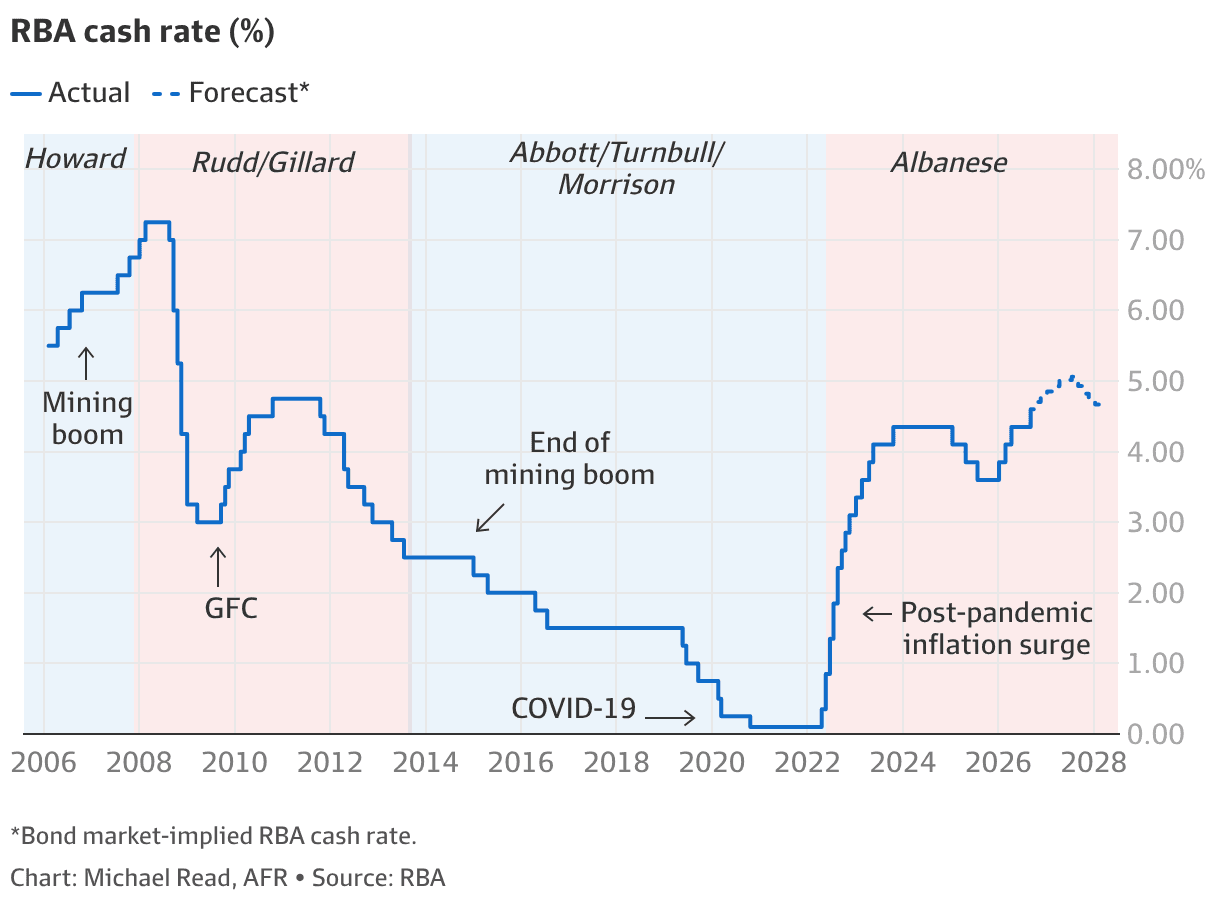
The Reserve Bank of Australia (RBA) has raised its benchmark cash rate to 4.6%, the highest level since 2011. This move, the fourth increase this year, comes amid persistent inflation and warnings from the RBA that further hikes may be necessary if price pressures do not subside.
- Cash rate increased to 4.6%, highest since 2011.
- This is the fourth rate hike in 2026.
- RBA warns of further increases if inflation remains high.
- Inflation has been above target for most of the past six years.
Inflationary Pressures and RBA’s Rationale
RBA Governor Michele Bullock stated that inflation has been persistently too high for the majority of the past six years. The RBA board voted unanimously for the rate hike, citing elevated prices driven partly by the AI investment boom and concerns that businesses may pass on rising costs to consumers.
- Governor Michele Bullock cited persistent high inflation as the primary driver.
- The RBA board’s decision was unanimous.
- Concerns exist about businesses passing increased costs to consumers.
- AI investment boom is also noted as a contributing factor to price rises.
Global Factors Impacting Australian Economy
Governor Bullock specifically highlighted the ongoing US war on Iran as a significant factor contributing to sustained higher prices. The conflict’s duration and potential to disrupt oil supplies longer than anticipated are seen as key drivers of permanently higher fuel, fertiliser, and transport costs.
- The US war on Iran is identified as a major inflationary factor.
- Disruption to oil supply is expected to be longer-lasting.
- Fuel, fertiliser, and transport prices are projected to remain permanently higher.
- This global instability adds to existing domestic inflationary pressures.
Economic Outlook and Inflation Targets
Data expected to be released soon is predicted to show underlying inflation rising at an annual pace of 3.6% in August, significantly above the RBA’s target range of 2% to 3%. While the economy is showing signs of slowing as anticipated, the RBA remains prepared to implement further rate increases if needed to curb inflation.
- Underlying inflation expected at 3.6% annually for August.
- This figure is well above the RBA’s 2%-3% target.
- The economy is slowing, but further action may be required.
- RBA aims to bring inflation back within its target range.
Potential Impact on Households and Property Market
Bullock acknowledged that the decision to raise rates will significantly impact some households, particularly mortgage holders facing increased repayment costs. She expressed hope that these measures will prove beneficial in the long term, leading to a reduction in inflation within the next few years.
However, she also cautioned that if households begin to accept current inflation levels as the new normal, more drastic economic slowdowns might be necessary.
Avoiding a Recession
Despite the potential for a significant economic slowdown, Governor Bullock indicated a desire to avoid a recession and minimise job losses. She suggested that further interest rate rises might not be necessary if inflation can be managed effectively without causing a substantial increase in unemployment.
- Higher rates will increase mortgage repayment costs for many.
- The RBA hopes the measures will be ‘worth it’ in a few years.
- Acceptance of high inflation could necessitate a ‘dramatic slowdown’.
- Avoiding a recession and job losses is a key consideration.
RBA’s Stance on Future Hikes
The RBA board’s statement indicated a clear readiness to lift interest rates further if economic conditions demand it. This stance underscores the central bank’s commitment to its inflation mandate, even in the face of potential economic headwinds and public concern over rising living costs.
- The RBA will continue to monitor economic data closely.
- Further rate hikes are contingent on inflation trends.
- The bank aims to balance inflation control with economic stability.
- The current economic climate requires a cautious and data-driven approach.
Conclusion
Australia’s central bank has taken a firm stance against rising inflation by increasing the cash rate to a 15-year high. This decision reflects concerns over persistent price pressures, exacerbated by global events, and signals a potential for further tightening if inflation does not recede towards the RBA’s target.
While the immediate impact on households is acknowledged, the RBA prioritises long-term price stability.
The RBA’s commitment to its inflation mandate is clear, even as it navigates the delicate balance between controlling prices and supporting economic growth. The coming months will be crucial in determining whether these measures are sufficient or if further, potentially more impactful, interventions will be required to steer the Australian economy back towards its desired inflation trajectory.
What is the current cash rate in Australia?
The Reserve Bank of Australia has raised its cash rate to 4.6%, the highest level since 2011.
Why did the RBA raise interest rates?
The RBA raised rates due to persistent high inflation and concerns about businesses passing costs to consumers.
Could interest rates rise further?
Yes, the RBA has warned that further rate hikes are possible if inflation remains elevated.
What is the RBA’s inflation target?
The RBA’s target range for inflation is between 2% and 3%.
What is the expected inflation rate for August?
Underlying inflation is expected to be around 3.6% annually for August.