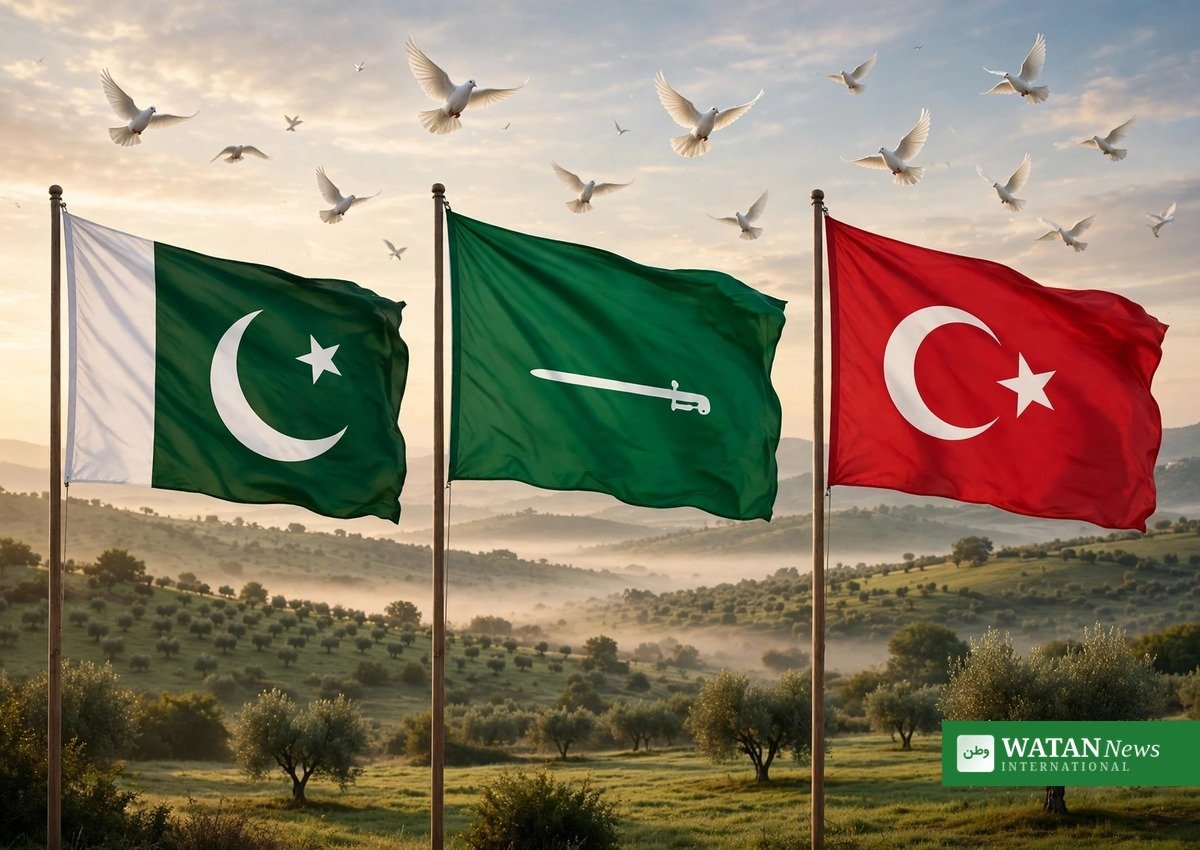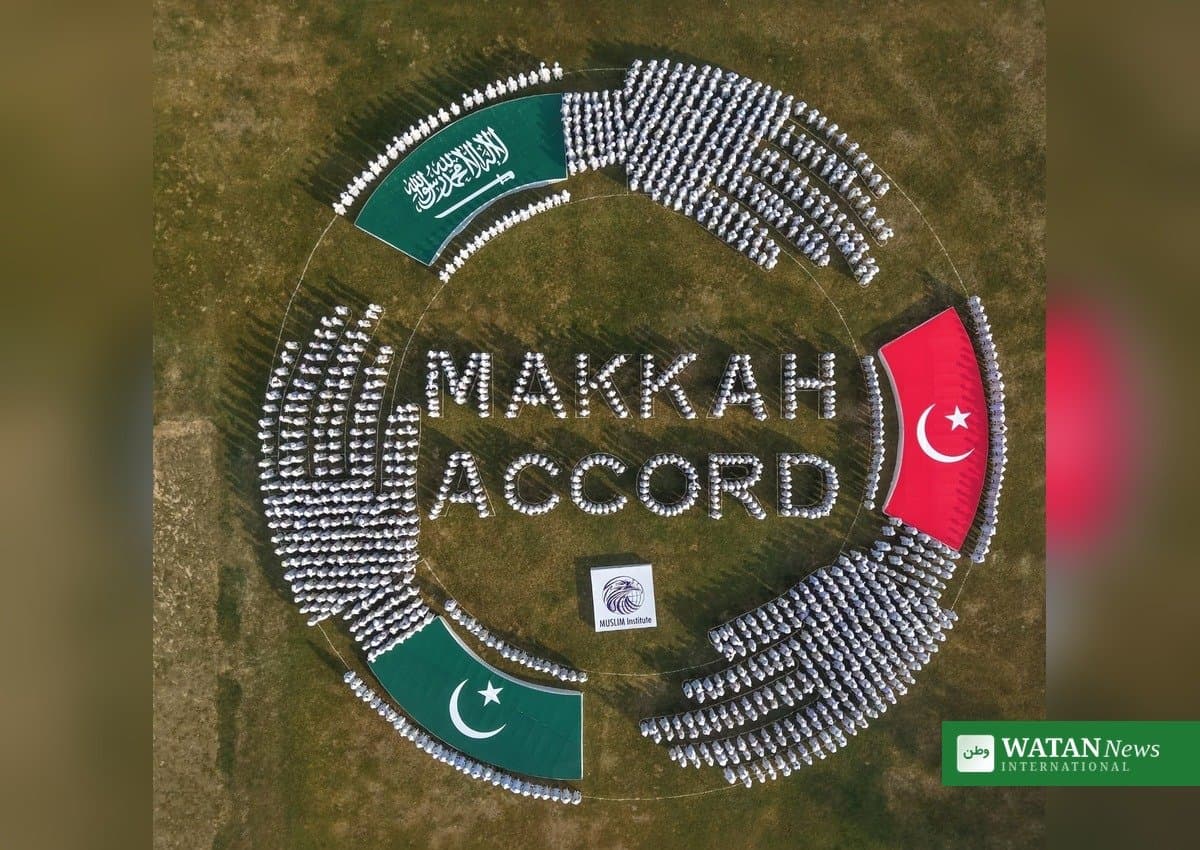
Thousands of people gathered at the Shrine of Sultan Bahoo in Jhang, in Pakistan’s Punjab province, to form a giant human display spelling out “MAKKAH ACCORD”, in a public show of unity between Pakistan, Saudi Arabia and Türkiye. The formation, organised by the research organisation MUSLIM Institute, placed the flags of all three countries around the display, while the national anthems of the three nations were played and participants raised slogans of “Islam is Peace”.
The display was reported on 20 October by Pakistan TV and Infora News, and an aerial photograph of the formation, showing the words formed by rows of people in white on the shrine’s grounds, has since been widely shared. According to the organisers, the event was meant to highlight the Makkah Accord between the three countries and its emphasis on collective defence and national sovereignty.
FAKTA
- Thousands of people formed a human display spelling “MAKKAH ACCORD” at the Shrine of Sultan Bahoo in Jhang, Pakistan.
- The display was organised by MUSLIM Institute and featured the flags of Pakistan, Saudi Arabia and Türkiye.
- National anthems of the three countries were played and slogans of “Islam is Peace” were raised.
- The Makkah Accord was signed by Pakistan, Saudi Arabia and Türkiye in Makkah on 7 August, with a central clause treating an armed attack on one signatory as an attack on all three.
- MUSLIM Institute chairman Sahibzada Sultan Ahmed Ali cited Article 51 of the United Nations Charter, which recognises the right of collective self-defence.
Makkah Accord human formation: a living message on the ground
Seen from above, the formation reads as a single circular display. Rows of participants in white clothing form the letters of “MAKKAH ACCORD” at the centre, ringed by the green flag of Saudi Arabia, the red flag of Türkiye and the green flag of Pakistan, with a board carrying the MUSLIM Institute’s name placed inside the circle. The institute said the gathering was designed to convey solidarity among the three nations and to underline their shared commitment to unity, peace, mutual cooperation and collective security.
Speaking to Pakistan TV Digital by telephone from Jhang, the institute’s media coordinator Shujat Ali said human formations had long been one of the organisation’s distinctive ways of expressing a position on international developments. He said the institute’s established presence and facilities at the Darbar of Hazrat Sultan Bahoo made it easier to bring large crowds together there than at other public venues, where gathering five to ten thousand people required considerable planning and coordination.
What the Makkah Accord says
The Makkah Accord, formally the Makkah Joint Defence Agreement, was signed by Pakistan, Saudi Arabia and Türkiye in Makkah on 7 August. Its central provision states that an armed attack against any one of the three countries will be regarded as an attack against all three, establishing a framework for collective defence. MUSLIM Institute chairman Sahibzada Sultan Ahmed Ali described the accord as a significant step towards strengthening collective security and safeguarding national sovereignty, and stressed the importance of cooperation among Muslim countries in addressing shared challenges and promoting regional stability.
Referring to the legal basis for collective self-defence, he cited Article 51 of the United Nations Charter, which recognises the inherent right of individual and collective self-defence in the event of an armed attack. Pakistan’s Foreign Office announced in September that retired Lieutenant General Nauman Mahmood would serve as the accord’s first secretary-general for a three-year term, with a secretariat in Riyadh. In early October, Pakistan’s Foreign Minister Ishaq Dar said the pact’s members would hold an emergency meeting in Riyadh and that more than six countries were keen to join, though new membership could not be considered until the pact was fully operational.
Why the institute chose a human formation
Shujat Ali said the human formation format had become one of the institute’s key strengths. After the 2019 Christchurch mosque attacks in New Zealand, in which 51 people were killed, the organisation created a human model of the Al Noor Mosque, an initiative he said received international recognition. He also cited a human formation depicting Pakistan’s J-10C fighter aircraft following the 2025 Pakistan-India conflict, describing it as another initiative that attracted international attention.
“This innovative approach has become one of our key strengths and is the main reason we chose this format to highlight the Makkah Accord,” Ali said. MUSLIM Institute describes itself as a research organisation focused on promoting peace and stability in the Muslim world, bringing together researchers, policymakers and intellectuals to examine security, political, economic, social, health and energy issues through research, publications, conferences and online forums.
The Jhang display comes as the accord continues to draw public attention across the region, with the institute saying its message was deliberately simple: unity, peace and coordinated efforts to protect shared interests. For more on Watan News coverage of the region, visit Watan News.